Archive: April, 2026
Coder's log: Refactoring the tagging stuff
posted by Jeff | Wednesday, April 29, 2026, 4:25 PM | comments: 0While I was reasonably confident in the quality of that previous coding session for tagging, it turns out that it left a lot to be desired.
First off, looking harder at the queries it came up with for hitting the database, one required a full table scan every time, another needed an index to avoid that. The "you're prompting wrong" crowd would argue that you should have told it that, but this is basic wisdom that a developer would have early in their career. It's not even something I'd expect to be specified in requirements, because it's an implementation detail that devs just know.
Then there's the weird stuff it does, like invent extension methods for things that already exist. It seems that the bigger a system gets, the more the robot tries to build things that already exist. I find that I often need to point it at things as a starting point so it doesn't do that, which requires that the human still knows and understands the system. That's really at odds with the tech bros who think they can ship a big system and expect it to scale and be maintained.
So the refactoring and testing, which found a lot of problems, took another two hours, bringing the entire time investment to about five and a half hours. That's pretty close to the estimate I made about me doing it myself. Granted, that's total working time, not accounting for ADHD side quests. Using AI agents is absolutely fantastic, but there's a lot of nuance in the actual benefit involved.
Energy independence is already possible
posted by Jeff | Tuesday, April 28, 2026, 12:22 PM | comments: 0A few years ago, I made a video about gas prices. Since oil is a global commodity, no one nation can corner the market on its production, or just use its own or whatever. I explain it in the video. If I were making that video today, I'd mention that while you can't control supply and demand as a president, you sure can screw it up by bombing a country in the Middle East. Especially the one where we had a nuclear regulation deal that the moron in the White House cancelled, making the threat that they can move toward nuclear weapons again.
Naturally, gas prices suck right now, which affects the price of everything. You keep hearing about "energy independence," and how if we just had more oil and controlled the oil, we'd be set. But imagine, if you will, a world where we didn't need the oil. If only there were technologies and energy sources that could replace it. Obviously that's sarcasm, of course we have that today.
Renewables are just about the cheapest form of energy now. That's a bummer if you've invested in infrastructure to burn fossil fuels, but it's true. If you're looking to get ahead of demand, and you're a utility, you're looking at renewables. Solar and storage (batteries) are especially appealing, since we won't ever run out of sun, and it shines to various degrees everywhere. Neat, right?
There's also a security benefit when you distribute that generation into smaller chunks. A single site that produces power for millions becomes a single point of failure. If you have smaller units, like rooftop solar on homes, and maybe a neighborhood or town sub-grid, losing one spot doesn't put out an enormous area.
Why isn't this already a thing? Money in politics, and pure willful stupidity. If anyone in Washington really cared about energy independence, they would embrace the solution that exists. It's illogical.
My house produced 50 kWh of electricity yesterday, and my cars don't need gas. I don't have the roof to be totally off-grid, energy independent, if you will, but a lot of people do.
Coder's log: Working with Claude
posted by Jeff | Saturday, April 25, 2026, 6:55 PM | comments: 0TogetherLoop has really come together, and it's more robust than I imagined. Again, I don't know if it's a real business, but I really like using it. One of the last big features to add is tagging. I'm not married to the way any platform does it. My version has to be private, and your post can't leak into other feeds or vice versa unless you've allowed it. I'm particular about the way everything works, so I'm not going to "vibe code" it. This is a log of my interactions with Claude to get to the end.
First off, I had a conversation with the AI about query efficiency. It's gotta perform well, but honestly, SQL is not my strong suit. I had a back and forth about schema design, about five iterations, when we got to a point of agreement. (I'm personifying the machine with "we," but "Claude and I" is too wordy.) We arrived at a place with minimal changes, were essentially a tag is recorded as its own entity, but the tagged person has a post placeholder that points to the original. They get a notification that to approve it, which flips a "IsAccepted" to true. Then we can make sure that the placeholder points to the post in their feed, but a third person only sees the original if they're friends with both people. No dupes. This took about 15 minutes.
Then we talked about the display of the tags, which I want to have fresh profile photos and names. I wasn't thinking about this, but Claude suggested a secondary query to decorate the posts for the feed. Duh, I do this in POP Forums. Signatures and avatars come in a second query, then we decorate the objects. I did this 20 years ago because I sucked at SQL, but it turns out this is a very efficient way to build output, and the performance is excellent. We discussed this for 20 minutes.
Next I asked the machine to propose implementation, and ask questions. After the first round, I told the AI to make the UX out of scope. Engineers already suck at UX, but the machine can be worse. It asked a lot of good questions, mostly about edge cases and other rules. It proposed multiple states for a pending tag, but really it just needs to be yes or no. I shrunk the scope down further, until I was satisfied it was just enough. (Sidebar: This is how I run dev teams, too. The smaller the swing, the larger the success.) This took 10 minutes.
I unleashed it on the proposed implementation (in a branch I could throw away, of course), which took about 14 minutes. It changed 30 files, which is a non-trivial review. My guess is that a lot of organizations with quality problems get into trouble here. Trust-but-verify can be labor intensive, and honestly, I think I should have narrowed scope more.
During my review, I found an instance where it created a class with just one property, something that it does a lot, though I'm not sure why. It seems insistent on wrapping anything sent over the wire as its own type. There were some other questions I had, and Claude had reasonable pro/con arguments for its decisions. I left them as-is. The bigger issue was that the database migration failed. It took several rounds to undo the bad script, which had me concerned, and required extra work to make sure it was OK. This took 40 minutes.
Next I had the AI do the UX for selecting tags, kind of an auto-complete thing as you type in a modal. With tweaks to the look, it took 20 minutes. Next was the cycle to shape the notification and its approve/reject path. While the approval is possible right in the notification, obviously you might want to look at it first. So I had to add the approval mechanism to the post itself. But then it still struggled with the queries and such to appear correctly in the profile feed, and the "my" feed. Along with design preferences, this took at least 60 minutes between Claude's revisions and my evaluation.
At this point, the PR is 900+/41- lines of code, across 38 files. My timing wasn't precise, but it looks like about three hours of work, between me and the robot. Letting it sit, I found that it didn't comma-dileneate the tag list, as I asked. It also didn't sync the approve/reject action buttons between the post itself and the notifications. After 10 minutes of back-and-forth, it had a solution, but it wasn't a good one. It wanted to open up entirely new ways of sending notifications, instead of through the existing message bus and processor. It also put logic in the repository layer instead of the service. These are the kinds of things that disappoint me, when you have a well developed pattern, and it decides to reinvent it. I usually catch this in planning, and it's why I can't just let it loose. This took about 30 minutes total to get right.
So overall, feature idea to implementation in about three and a half hours. How long would it have taken me? Because I'm familiar with the code base, probably five hours. If I wasn't familiar, maybe a little longer. I had to do a lot of redirecting, even though it had a code base with tons of established conventions. Can you imagine what would happen unsupervised? You'd have notifications following a half-dozen paths, for example. And this is with a well revised CLAUDE.md file and a ton of rules.
Updating all the things for security
posted by Jeff | Thursday, April 23, 2026, 7:40 PM | comments: 0I've been feeling melancholy today, for a number of reasons, so I needed something to kind of dig into that's quasi mindless but at least in some way productive. I saw a story about a particular open source vulnerability today, so it seemed like a good time to update all of the things. It's a boring task, but it requires a lot of testing in case the change or fix breaks something else. Most of the time it doesn't, but if what you have is too far out of date, it'll likely break. AI isn't great for this, because it just doesn't have enough context in the moment to know what to look for.
On the other hand, I had some free extra credits from Claude (they sure know how to bleed cash), so I unleashed it on TogetherLoop to find security problems. It found four, but only one was serious, and not one that I would have ever thought about up front. But the funny thing is, it was in code that it had written. This is one of the many strange things about agentic coding, that it does a lot of dumb things, unless you ask it to check for the dumb things.
I had it scan POP Forums, too, and it found some minor things around possible script injection attacks. The app as a whole, having evolved over so many years, has a lot of competing actions. Parsing text is always kind of weird, and it's the worst part of the code. But also, sometimes it parses stuff then stores it, other times it stores it then parses it. That's where the risk was. Meh, no one else saw it, so I guess it's fine-ish. All fixed now.
These AI agents are fantastic, but the LLM's that they use are definitely at risk to rot. They're trained on all kinds of information and code all over the Internet, without the wisdom to know what's good and what isn't. But also, if those sources disappear, and they probably will if no one uses them, what does it train on? If it trains on itself, it will devolve and suck. Google's AI summaries present the same problem. If all of its source material disappears, because no one actually follows the links to it, then what?
Agentic AI coding's missed opportunity
posted by Jeff | Wednesday, April 22, 2026, 10:32 AM | comments: 0I'm going to indulge myself a little with stories of grandeur. It'll sound a little braggy, so I apologize in advance. There is a point though, I promise.
The team in my last gig was completely awesome. Certainly they would have to be if I were to stay with them for four years. Not working with them is the hardest part of the RIF. What made it a great team is that we stayed ahead of everything put in front of us. Instrumentation was there from the start, performance was always meeting SLA's, and maybe most importantly, our backlog was fairly shallow most of the time. It's not that we didn't have tech debt, because you're always making certain compromises, but we didn't have a lot of it. We made mistakes early, iterated and delivered the better thing as fast as possible. And we did it without crunches or code freezes or exhausting everyone. My product partner was totally aligned, and while we debated things freely, there was never conflict or tension.
And even as we were sometimes sent on wild goose chases in the last six months, our core projects never got out of control. The team was using AI agents quite a bit by then. There were some PR's that churned a bit during this time, as the team was still feeling out the appropriate level of trust in the robots, and understanding what they were putting out, but I equate this to onboarding a new, junior engineer. That backlog was still not super deep.
As I've said many times, coding as a part of the entire SDLC is tiny relative to everything else. Deciding the "what" and "when" is a lot more work than the "how." Engineers should spend way more time understanding context, making design decisions, documenting, testing, reviewing each other's code and collaborating with other teams. Agentic coding frees up time to allow engineers to do all of that stuff, which makes them better equipped to direct the AI. Time spent coding, or making the machine do it, is even further reduced.
But as I said, that time savings is a sliver of the bigger cost. Include all of the stakeholders, and the what/why dwarfs the how. AI does not create a shortcut for this. It does create an opportunity.
My team was so effective because the what/why was so dialed in. My product manager and team worked so hard to understand the bare minimum thing to build, did it, and iterated. Freeing up the build time meant that we could focus more on the long-tail work in the backlog. The last system we built never went down in two years, and always met SLA's in terms of response times. It got even easier to stay on top of that when coding took less time.
This brings me to the bigger point. Some folks are so enamored with the shiny thing that they disregard outcomes. Yes, you can build faster, but what are the outcomes? If you shipped broken things in constant need of fire drills, that won't get better with AI. LLM's only mirror what they've seen, and most software isn't very good. Great, you have more PR's or more lines of code, but was that ever a useful measurement for humans? (Of course not!) The biggest opportunity with AI is that we have more time to get it right, address tech debt and keep that backlog tight. Use your found time to make your product robust and resistant to constant emergencies.
The Six Flags disaster
posted by Jeff | Tuesday, April 21, 2026, 7:16 PM | comments: 0We're reasonably self-aware over on CoasterBuzz, in that while we all armchair CEO the amusement business, we're not pros. But we've also gotten a lot of things right. Leading up to Six Flags' bankruptcy in 2009, we could all see bad ideas in action. Give away the gate, try to make it up in volume and spending. Of course this never panned out.
Then whatever the company was most recently, it had mostly been doing the same thing. The former CEO admitted that they needed to reverse that trend, but the damage was so done. So what did they do? Approached Cedar Fair about a merger. There was zero upside for Cedar Fair to do this, which was already slightly leaning into the heavy discounting and pass reliance. Their growth was not outpacing inflation. But for whatever reason, they thought the merger was a great idea, and found a loophole where they didn't require a shareholder vote.
You know the rest of the story. Total meltdown, lost a ton of money. They recently sold some parks. Massive layoffs. The new leadership hasn't exactly been inspiring, and there's no concrete plan about digging their way out of this mess. But those goofy enthusiasts have, again and again, shown better judgment.
First, why would you let your gate integrity slip? Why race yourself to the bottom? These are regional businesses that have no direct competition. Even if you did attract more folks, at those lower rates, you're attracting people who are not likely to spend more in the park. They're probably not the best behaved, either, when you're essentially creating a low-cost babysitting service.
Second, amusement parks are a hospitality business. Hospitality is hard, and in this case you have to account for guest service, culinary quality, efficient operation to manage queues, and often there's a hotel business. It is, by definition, a people business. Ever wonder why the cruise industry has guest to crew ratios of 3 to 1, or even close to 2 to 1? Because pulling off a perfect experience doesn't happen without people. Take a break from cap ex and staff the company for hospitality.
Now there's a great brain drain. They've laid off hundreds of years of experience, and when it walked out the door, domain knowledge went with it. Still more left on their own accord. How do you dig your way out when the people who can do it are gone?
Cedar Fair had a solid, profitable business. They weren't killing it with gigantic margins, or exhibiting significant growth (because how can you with a finite audience?), but it was a durable business. The hubris to take on Six Flags was extraordinary, and they're forced to sell the company for parts. Meanwhile, ex-CEO Richard Zimmerman left with over $2 million in cash, another million in equity, and that's after more than $9 million in total comp the year before. If only we could all fail that well.
The state of public perception of autism
posted by Jeff | Tuesday, April 21, 2026, 4:17 PM | comments: 0One of the standout story lines on The Pitt is that of Dr. Melissa King. She and her sister both have autism, and while the sister requires extra care, she's, well, a doctor. Early in the series it's probably not even obvious that King is a lot like her sister, but through a series of events and patient encounters, it's clear. What I love about this is how it demonstrates the, er, spectrum or range of capability of folks. I might even say that it shows how labeling people as "on the spectrum" is largely meaningless. I suspect that there are aspects of every person that could put them there, even in the narrowest of ways.
Why does this matter? Aside from every annoying hot-take on the Internet (now adding mine!), it's the stupid shit that RFK says, or the insane false statistics about employment rates, relationships and such. Contrary to Kennedy's nonsense, I'm married (twice!), have worked lucrative jobs and I'd like to think that I contribute to society in various ways. With that in mind, I also understand that there are people, especially kids, who might not even be verbal.
Now, what I'm about to say is with the experience and journey of not being diagnosed until I was 40-something, watching my kid grow up with so many similar personality traits and my observations about advocacy groups. What I see is that advocates see accommodation as the same thing as being "seen." I'm not a fan of this. I totally appreciate the desire to see people for who they are, but it doesn't mean that we don't help by making learning unnecessary. Let me explain.
I understand now that I've developed a great many coping skills to work in a neurotypical world. No one decided this, it was just necessary for my survival. I wasn't even diagnosed. These skills, I think, have served me well, even though I've had a tough time with relationships of all kinds, personal and professional, and I still have blind spots. Life has never been easy, but if endless shortcuts were provided for me, I suspect life would be even harder.
What I like even less is people who talk about "masking." This is the suggestion that people are inauthentic in order to fit in. For better or worse, there are certain social contracts we value, regardless of neurodiversity. I'm not talking about difficult eye contact or proximity discomfort, I'm talking about you don't kick people, you express kindness and just generally try not to be an asshole. (Apparently you can be elected countering all of these.) Autism does not inherently make you an asshole, so what exactly are we talking about with regard to masking? If you're perceived as weird, you know, let your freak flag fly. ASD or not, it's not up to others to put you in a box.
I advocate being empathetic to people who find their flavor of autism causing difficulty. It's not that you have to accommodate them, just be empathetic. Empathy by definition is being seen. Yes, sometimes in a loud room or in a crowd, I need to GTFO. I need short breaks from parties. The key is being honest about what I'm experiencing, and telling others. They're generally empathetic. I don't have to mask anything.
There is some icky stuff out there. At home we've been fighting the accommodation versus accountability problem quite a bit, because in retrospect there were so many shortcuts provided. Surely there's a better way to find a balance. I also think they need to get back to some delineation of symptoms and capability, because so much is piled into "ASD" that it's hard to have good conversations about how best to help people, or even decide how much help they need. We also need to ask neurotypical people to stop prescribing solutions that don't make sense.
Ugh, I'm just ranting. It's not easy to organize my thoughts at the moment. So many things going on. I think this is just me letting Internet randos get to me.
My dirty little secret about AI coding
posted by Jeff | Tuesday, April 14, 2026, 4:58 PM | comments: 0I have to make a confession. The biggest reason that I love using AI agents to write code is that I just want to get to the outcomes quickly. Sure, I have to check the work of the robots, but it's faster than me writing it, even with robust auto-complete. I know a lot of engineers feel pride and excitement about pecking out solutions to stuff, but if I'm being honest with myself, I don't think I ever enjoyed it.
That said, if AI hit at the start of my career, I wouldn't be where I am.
I fear that there's a structural problem with the use of agentic coding. I'm not suggesting we don't use it, far from it. But I am saying that we could have a problem with the up and coming folks if they're uninterested in what's actually happening with the code. That's how I was when typing was the only way to write code.
I think I was a little slow to really understand object-oriented programming (or scripting for that matter), because my entire incentive for learning in the first place was to get to the outcomes I wanted. I started as a media guy who just wanted to put stuff on the Internets, so programming was a means to an end. I just happened to turn it into a career. It took years before I felt like I was "good" at it, and even when I felt competent, my output was so much lower than my peers because of my then-undiagnosed ADHD. If I had AI back then, I doubt I would have gone very deep on what the machines wrote, as long as it worked. By extension, I would have never gained an appreciation and love for system design, the part that I enjoy the most. In other words, I'd be a vibe coder that didn't know how my stuff worked.
That puts us in a weird place. If we're not mentoring and coaching our junior devs, who will be the senior devs of tomorrow? LLM's are just sophisticated word guessers, and they get worse if they're training on their own output. (Is there a term for this? The thing where LLM's get racist and generally worse without bona fide "good" input?) The trust and verify approach is going to be with us for a long time, and when something breaks, good luck blaming the AI. Going back to my own focus on outcomes, nobody cares... customers, users, stakeholders... if AI wrote the code, they just want a working system.
Replacing the pinball rubber
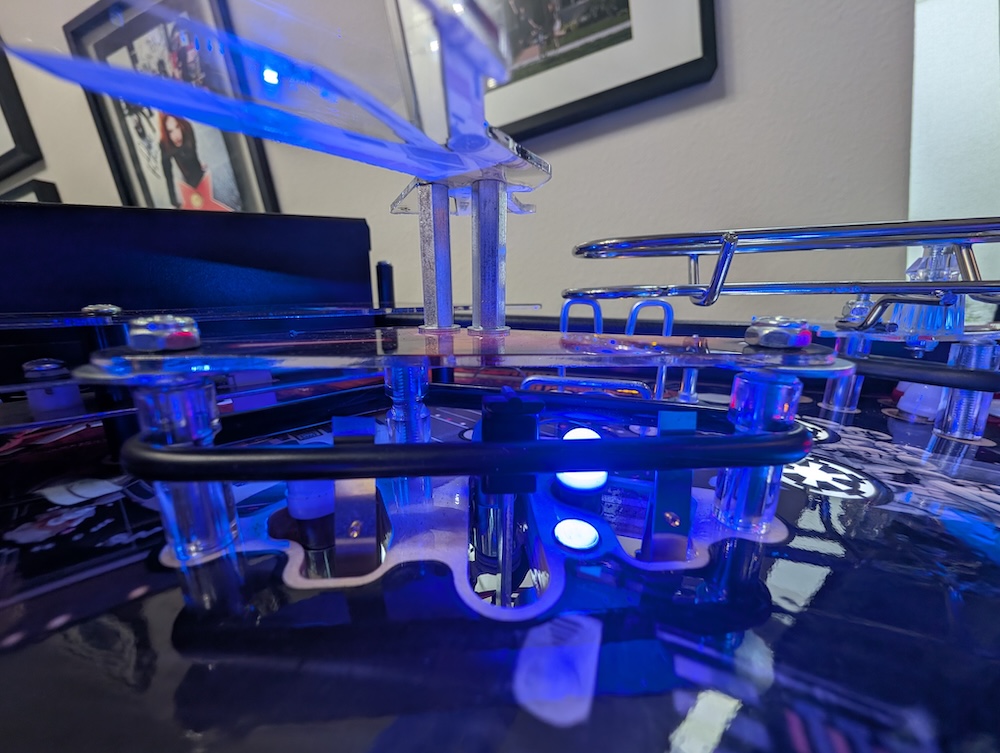
posted by Jeff | Thursday, April 9, 2026, 8:16 PM | comments: 0I spent a little time replacing the easy-to-reach pinball rubber bits this afternoon. There are others to swap out, but they require more disassembly of plastic layers to get to, so I'll wait a bit. Most urgent were the slings, which were cracked and shedding, and the post sleeves between the various ramps. They were in really bad shape. I decided it was time because I could see them disintegrating, which I'm sure contributes to the quickly reoccurring dirt. We've already had 2,644 games played, so well on pace for 5k before the end of the year. I bought silicone replacements, which last longer, though purists apparently don't like those. Meh, they seem about the same to me.
Once again, I point out that pinball maintenance is very therapeutic, if fixing stuff relaxes you. It's such a great combination of electronic and mechanical stuff. I imagine that they're a ton of work in a commercial environment, but regular cleaning and attention keep them running tip-top. I'm sure the first big replacement will be the flipper linkages, but for now they're still pretty firm.
Also, today I exceeded 1 billion points for the first time.

The Disney Destiny
posted by Jeff | Wednesday, April 8, 2026, 5:23 PM | comments: 0With all of the drama right after we returned from our latest cruise, I completely neglected to write down a few thoughts about the new Disney Destiny. This is the third of the Triton or Wish-class ships. The general layout and function of the spaces is about the same, but the decor and theme is very different on each one. We did the Treasure in August, and it remains our favorite of the three. It's just the level of detail in the mid-east themes on that one that level-up the decor. I like the various carpet designs and what not, too. The Wish is nice too, it's just not as good as the other two.
The grand hall on Destiny leans into the design found in the Black Panther movies. Literally every detail refences something from that movie, and if you take the tour, they'll point those details out. But it's super lame that none of it is made out of vibranium. Just kidding, that's not real. The overall theme is attributed to heroes and villains. This makes a lot of the art extra unique (there are thousands of pieces on every ship), and it serves as a backdrop for many of the venues. Saga, the two story "Luna" venue, continues with the Wakanda-inspired texture, and I really liked that area. The open "family" bar on this one is called the Sanctum, referencing the Dr. Strange movies. The dinner theater venue is Lion King themed, and the music borrows heavily from the stage show's African themes instead of the movie pop music.
I don't see a lot of point in getting into all of the details, because they don't differ enough from the other ships. We did see no less than four previously known bartenders on this one, and it's always fun to catch up with them. A lot of things had new-ship smell, so it's kind of neat to be among the first few folks occupying a room, for example. There's a thing where they produce these wooden mock-ups of each ship, and we collect those. We now have the entire fleet, except for the Adventure, which I'm not sure counts. It's a one off thing, a ship designed for a defunct company, that they Disney-fied and sent to Singapore. It doesn't go anywhere, it is the attraction. So it's kind of like a resort and park at sea. I doubt we'll ever see that one. If I'm going to go to that part of the world, I'm not going to spend days at sea not seeing stuff.
It's worth noting that this one departed from Ft. Lauderdale, which is a new port for us. We drove about two-thirds of the way down the night before and stayed in a hotel. It was mercifully a non-event as far as travel and teen behavior goes. The terminal itself is pretty awful. It gets so loud in there, and this was also the highest capacity that ship has seen, so it was crowded (spring break in Florida). I was just pissy and angry when we disembarked, I guess not for any specific reason, other than maybe knowing we had to drive three hours home.
I wish we had better ports. Cozumel is a dump, and I much prefer the newer Disney island over Castaway. Not that it mattered, because the weather was pretty bad, and we didn't even get off. That's like three straight cruises of suboptimal weather for the beach day.
Next up is Wish again, and we're going VIP, because we deserve it and it's our 19th first-date-aversary. Just learned that next summer they're sending Wish back to Europe for drydock treatment, and having the Dream service Canaveral for the Bahamian itineraries. I'm a little nostalgic about that, since it was our first cruise ship, the one we had in Europe and 16 itineraries overall.

Emotional battery vs. bandwidth
posted by Jeff | Wednesday, April 8, 2026, 4:31 PM | comments: 0You know how people talk about "recharging your emotional batteries," usually in reference to a vacation? I'm convinced that it's not a thing. I think the constraint is bandwidth, not storage. My therapist might even agree with me.
Humans have to endure a lot of things, and so many of them are psychological. I don't think that exposure "drains" something, per se, but I do believe that there's a limit to how much you can take at any given time. When you reach that limit, you kind of turn-off, melt-down or otherwise feel like you're imploding. I think the threshold is definitely different for everyone. It seems pretty low for my kid, but then everything feels like a crisis when you're a teenager. I used to think that mine was pretty high, but the volume of challenging things in the last month or so has been brutal. I've just wanted to retreat into a cave and not come out. The recent vacation didn't help.
So if you can identify the bandwidth problem, it follows that you should be able to come up with some kind of coping skills. Backing off of social media (except for TogetherLoop, of course) helps. Limiting your news intake, too. It's the things that you can't get away from, like parenting, or seeing your spouse hospitalized, that can get to you. They certainly have caused me to struggle.
TogetherLoop architecture uses all the things
posted by Jeff | Monday, April 6, 2026, 5:01 PM | comments: 0Since I've completely over-committed on my various online projects, I have a lot of spare capacity. CoasterBuzz, PointBuzz and POP Forums all run on cloud resources that are intended to not be down, with redundancy and overhead to spare. TogetherLoop uses all of it. Here's a brief rundown of the various bits.
The one new thing, and I'm not married to it, is using Azure Front Door for the app itself. The client is a Blazor WASM app that weighs in at around 13 MB on first load. Cached, it's not even 100 kB, because there's nothing but the payload for the home page. And if that sounds like a lot, you should know that The New York Times home page has about 40 MB, and even cached it pulls 31 MB. Completely ridiculous. And my load buries Instagram's web interface. In any case, Front Door obviously georeplicates the static files around the world, since it is a CDN, but more importantly, it offers a lot of control over headers and such, so I can make sure that the app is never stale. This is costing an extra $20-something a month, but it's stupid fast.
The backend API is actually split between a regular Azure app service (two nodes) and a series of Azure Functions. The functions do a lot of async work, like processing photos and video, recurring billing (eventually), notification processing, etc. But they're also the key to scale for uploads, because the app service would certainly run out of memory quickly, even using streams. The app service is handling all of the JSON payloads you'd expect from an API, which also has no wake-up lag in responding, as the function do sometimes.
The media is all served directly out of a storage account. Technically these have no permission controls, but the URL's are all not guessable. So for them to be seen by someone who shouldn't, that's on your crappy friends. I can change this at some point easily enough, if I need a permissions layer to proxy, but that's a future improvement, maybe. I also have a policy where the media is downgraded from hot to cool after a few months, to save on costs.
I've got Redis serving as a message bus, to feed processed notifications back to the API nodes, which in turn uses web sockets (SignalR) to let the client know that something is new. The direct messaging uses web sockets as well, and is kind of a port from POP Forums, though that app uses mostly custom Typescript web components instead of Blazor.
Friend searching is through Elasticsearch. Searching for folks through SQL isn't great, and we don't need table scans slowing things down. In this case, it's using some fuzzy matching on name, or exact matches on email.
The primary data store is Azure SQL, because everything else using it so ridiculously tuned that average usage rarely gets over 3%. Sure, it's possible to outgrow that, but I need tens of thousands, maybe hundreds of thousands, of users to get there. Even then, there are a lot of pre-compute tricks I can use to help with performance.
Everything except Front Door is stuff that was already running for the other sites. Functions are technically their own cost, but I'm not stressing about those extra cents per month. Elastic is running in Azure but run by Elastic itself. The various forum indexes all live there, and it too is underutilized.
In the event that I can grow this thing into something, it's a solid foundation. Certainly a lot of premature optimization. I don't hate sub-50ms API hits from where I live.
Paradise is the best show I've seen in a long time
posted by Jeff | Friday, April 3, 2026, 11:25 PM | comments: 0Have you seen Paradise on Hulu? If you haven't, do your best to avoid learning anything about it, and watch it cold. I binged the entire first season in a day, because I couldn't look away. Now that the second season has wrapped, I'm just in awe. It's hard to pin it in any specific genre, and as long as you don't know too much, it just keeps surprising you for being something that you didn't expect. Also, Sterling K. Brown is a legit great actor. I enjoyed his work in This Is Us, and it wasn't a fluke. He's good.
I don't think a show like this could have made it in traditional, linear network TV. I'm grateful for that. Most of the best stuff right now wouldn't have made it on network, which is weird because for so long that was the prestige spot. Then again, HBO set a new standard, and that standard translated well to streaming, specifically HBO Max, Hulu and Netflix (with honorable mention to Apple TV+). Hard to see how all of the consolidation shakes out, but it's a great time for good TV.
In the role of appliance repair man
posted by Jeff | Thursday, April 2, 2026, 4:32 PM | comments: 0For a few weeks, I've been putting off dealing with a problem in my fridge. It's icing up in one corner behind the drawers. But yesterday I really needed a project to break up the day and give my head a break.
From what I could tell, the ice in one area meant that the system itself was probably fine, in terms of thermistors, fans, compressors and such. I found a diagnostic card online, and ran through the various functions by pushing weird key combinations on the freezer door. Everything returned normal. I could hear the fan whir up when it tested it, too. The Internets suggested that localized ice and good diagnostics likely mean long-term humidity exposure and possibly a door seal leak.
I busted out Diana's hair dryer and melted all of the ice after taking off a cover inside, and shop vac'd the water out. Everything was cooling as desired when I was done, and I took what seemed like a win. I guess I won't know until time passes.
It seems like appliance repair is so expensive that replacement is a better option, which I hate because things shouldn't be so disposable. Most appliances are pretty simple machines, and anyone can get parts on the Internet. I've replaced the ignitor on two gas ovens, the latter of which was only a year old. I've replaced the control board and gear box gasket on our KitchenAid stand mixer (leaking lube killed the board). Our LG clothes washer sprung a leak a few years ago, and I replaced the water valve assembly inexpensively. I wonder about the washer and dryer, which are now 15-years-old. Feel like I'm beating the odds.
I really value simplicity and serviceability in everything. Unfortunately, it doesn't seem like many things are made that way anymore. Maybe they never have been during my lifetime.
New job, no job
posted by Jeff | Wednesday, April 1, 2026, 11:30 AM | comments: 0Just before we embarked on our Destiny cruise, Diana got an offer for a new job. It's very exciting. She's going to work for the new Blue Man Group location here in town, in another front-of-house role. That means she's leaving DPC after 11 years, an incredible run, but there were a lot of good reasons for the change. It's not the worst thing either when her husband and son are also big BMG fans. The company is now owned by Cirque du Soleil, which seems like a pretty good employer, based of course in Canada.
I, however, am still looking. Admittedly, I wasn't trying very hard for that first month, but that means that I have been looking actively for the nearly two months since. It's rough out there. Granted, the level that I'm at suffers from a certain level of scarcity anyway. It's strangely exhausting to feel a sense of urgency all of the time, when you can only do so much in a day to try and land something new. We have a ton of financial runway, but honestly it's not the money that concerns me. I just want to get back to leading a team of makers. That's satisfying, and gets me up in the morning.
For now I'm spending a few hours a day on TogetherLoop, which I just opened to signups without invitations. Eventually I'll flip it to a subscription model. I have to get to writing that code now though, in case it accidentally gets popular. I don't see a reason why it would, but you never know.