Archive: July, 2026
The robot is pissing me off
posted by Jeff | Friday, July 31, 2026, 7:59 PM | comments: 0You hear a lot about the use of AI in various capacities, and one of the biggest is with regard to building software. The idea is that you prompt it to make stuff, and you get software. Meanwhile, people talk about "vibe coding" empowering non-software developers, and that's the end of jobs.
I'm here to tell you that's nonsense.
As I've said a billion times, vibe coding is like the AI slop that Trump posts. It conveys a point, but in its execution, it's dogshit. It can't survive any real production load or security standards. Human wisdom and experience still matters. When I said that I was building out subscriptions in POP Forums, I had a pretty good blueprint to start with. It has systematically, if unintentionally, tried to break it. And then, I asked it to modernize some of my build and deploy pipelines, and it just keeps throwing shit at the wall to see what sticks. What's infuriating about that is that those sorts of tasks are very much deterministic. There's an obvious outcome and only one real way to get there.
In so many ways, agentic coding feels exciting and game changing, and it is, until it isn't.
"Time is a bomb"
posted by Jeff | Friday, July 31, 2026, 7:27 PM | comments: 0There's this Metric song on their new album called "Time Is A Bomb." Emily, the singer and lyricist, is just seven months behind me in age, and I imagine she has a lot of the same thoughts as me, regarding our stage in life.
Now that I'm back to work, there's a little more routine in my life. I'm surprised that I've been at this job already for four weeks. It went by so fast. And I realize that I need to do more things to break up the week other than going out for lunch. I find myself comparing time periods in strange ways. Like, I moved to Orlando 13 years ago. And 13 years before that, it was 2000, and I was in my first marriage and had not even bought my first house. The volume of change is a lot lower in this last 13 years, aside from the growth of my kid. Well, that, and I've had seven jobs.
The funny thing is that the previous six months felt like an eternity. There were a lot of ad hoc goings on. If it weren't for the anxiety, I would vastly prefer that "eternity" feeling over the fast passage of time.
So this makes me think, gosh, how do I make sure that the next 13 years don't fly by? Hitting that (very) early "retirement"/offboarding target is certainly part of it. I also hope that with age, I give in a little to the inevitability of my demise. What a weird thing, that you can't feel bad about not making the most of your time when you're dead, but it can nag at you when you're alive. That's a cruel symptom of life.
Time really is a bomb.
I'm content, and it's weird
posted by Jeff | Monday, July 27, 2026, 6:56 PM | comments: 0I feel like anxiety and discontent has been the standard since the pandemic. I feel like it's been years of worry, insomnia and anxiety. Then, this weekend, something clicked. I was alone for much of it, but I felt content. I almost forget what it's like.
When I decided to tear down the "paid" forums, I also learned that there was a new, cheaper but better tier in Azure to host stuff, but it required a lot of manual movement and redeployment. Saturday night I started that work, after finishing up a beta version of my unofficial Hyundai app. I enthusiastically finished that up Sunday. It felt good to be making and shipping things, and I can't wait to do more. I've been really enjoying the new car, and looking for reasons to drive it. I've been more active about finding good new music. I just feel like I have more energy for all the things.
Naturally, I wonder why these feelings have been absent for so long. As recently as last week, I was stewing about the damaged fridge that Wayfair delivered and was slow to respond about. The car buying nonsense grated on me, because the sales process is just so full of bullshit. Prior to July, the job search was really getting me down, and it has been for months. Parenting has mostly been a nightmare this year. Diana's appendectomy and related issues had me on high alert for awhile. Oh, and everything the old man in the White House is doing is hurting the economy.
I feel like the last time I really felt at ease was on our vacation aboard the Treasure, nearly a year ago. "New" travel really helps, and that cruise felt new because of the new ship, and it was a solid week. Prior to that, we did DC in 2024, and Northern Europe in 2023. It's those longer trips that really allow me to release, but those are more short-term fixes. What I feel right now is just in-the-moment feels, which I haven't had in years.
Of course, I expect that something will happen to ruin the feeling. That's certainly one of the things that I struggle to change about my outlook. But dammit, I'm gonna do my best to go to bed relaxed, and one of these days maybe I'll have a continuous night of sleep.
What's next for POP Forums
posted by Jeff | Saturday, July 25, 2026, 7:33 PM | comments: 0Back in 2020, before everything closed up, I built out a multi-tenant version of POP Forums that you could buy. Give me money, and it magically provisions an instance of the forum for you. It's very customizable, which is why running on PointBuzz, it looks like it's part of the site. But the reality is that buying is a little clunky, and I've never done any marketing for it. I don't enjoy that or want to do it, and especially not spend money on it. So I've had one customer for one month. I made fifty bucks.
I'm probably going to tear it down, maybe save a few bucks on the hosting bill. I'll still have PointBuzz running its own forum, because it's easier to change the main site separately. But I'll also build a full on paid membership system into the forum by adapting the stuff I wrote for the hosted version. In other words, it'll be open source like the rest of the core forum. I suspect if I get that in place for PB, I'll make more in a week than I did in six years of selling the forum.
It's just so much faster to build software these days, because of the robot help. AI agents will do stupid things if you let them, which is why "vibe coding" is not a thing beyond prototyping. You need expertise to guide it, because LLM's are not capable of wisdom and judgment. They never can be, which is why you still need humans. Still, the speed helped me build a replacement Hyundai app because I didn't like the official one, in just a few nights.
I look forward to porting this subscription stuff to the forum product. It'll be the first major addition in a few years.
Review: Hyundai Ioniq 5
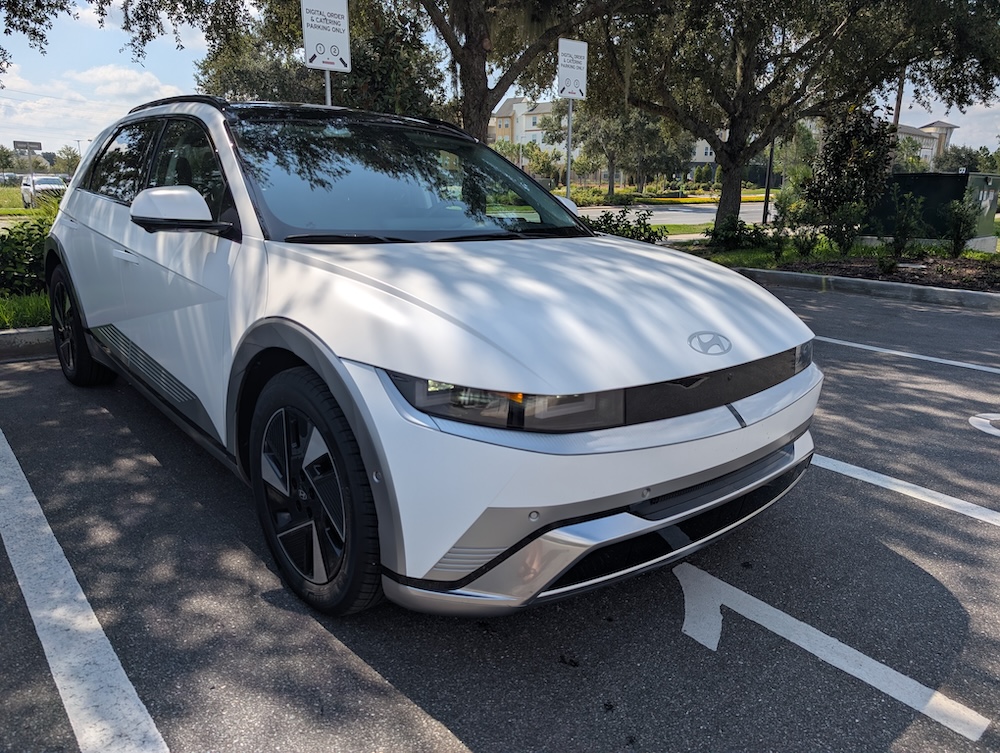
posted by Jeff | Friday, July 24, 2026, 7:12 PM | comments: 0All of our car history over the last 12 years has been Tesla, plus two leased Nissan Leaf's (the second of which was totaled in an accident). The Model S was exquisite. I loved that car, but didn't love paying for it. The 3 was solid, and then my Model Y was a rattling mess with poorly aligned body panels, even if it was mechanically sound. Diana's Y (which replaced the totaled 3) was better, but they've since ditched the steering columns stalks for more capacitive buttons. It's not even Elon's politics, given that 65k other Americans work for Tesla, it's that there are more choices, and I was ready for something different. So our seventh EV is an Ioniq 5 in the Limited trim.
Pricing and features
I ended up getting the car for about $41k, then with taxes and dealer fees, it was about $46k all-in. Sticker was $48k, but I used their financing that knocked $7k off, then paid it off two days later. For the first time ever, no new car payment with a new car! $41 isn't a cheap car, but it has all the things except for AWD, which would negatively affect range anyway. The cheapest trim with a smaller battery, after that financing, could be as low as $29k. The car is an extraordinary value. The Model 3 was $51k back in 2018. Diana's Y was $41 just two years ago, but that was with the $7,500 federal tax credit, which is now gone.
The American car makers (aside from Tesla) have largely abandoned mid-tier EV's, aside from the Chevy Bolt and Ford Mach-E. The German makers have some excellent, but pricy options. And the Japanese... I don't understand how they haven't been winning from the start, especially Toyota given the loyal Prius base they had. But the Hyundai group, including Kia (the EV6 is the same platform as the Ioniq 5), is really filling the gap.
The reason I was holding out for the Limited trim was that it has all the things, where the other trims do not. It's an enormous list, starting with no phone key (that was not negotiable), and also no HUD, no sun roof with shade, no rear passenger shades, no premium audio, no ventilated seats, no video rearview, no recliner seat for chilling, lesser or no driver assist features, no ambient lighting, no 360 camera view, no in-dash blind spot cameras on turn signal, no B-pillar air vents for the back seat, no auto sensing wipers, no folding mirrors... and I'm sure I'm forgetting things. Mind you, the Limited trim is $5k more, but it's a huge difference.
Driving
The tech is the cool stuff to me, but I should start with the actual driving experience. It's consistent with most EV's, in that it provides near-instant torque at any speed. It's not as much torque as a Model Y, and you can feel a slight difference, but in practical terms it's a non-issue. The 0-60 is slower, in that the AWD Y I've measured at a consistent 4.6 seconds, whereas the Ioniq is more like 6 (the AWD version is clocked at 4.4). I think Hyundai takes a conservative software approach, because it's a much smoother acceleration curve at the bottom. You'll still leave everyone behind you coming off of a red light, it's just not as punchy as the Y. Again, in normal driving, this doesn't matter. The important thing is that it's super fun to drive.
My Y feels every bump in the road, whereas this the Ioniq feels a little softer. It's a little quieter, too, though over air conditioning I'm not sure it's much different. I think the Ioniq rolls just a little in fast turns, which tracks since its center of gravity is higher than the Tesla. The Ioniq also has a longer wheel base, so in theory it feels more stable, and certainly is smoother.
There are two annoyances though. First, it doesn't retain the driving mode when you power down. So part of my routine has to be to switch it into sport mode every time. That stiffens up the steering a little and makes the acceleration more punchy, which should just be the default for an EV. I think the reason they do this has more to do with hitting efficiency and range targets than anything else, relative to regulatory scrutiny. The other thing is that it has different levels of regenerative braking, controlled by paddles on the steering wheel. It defaults to "level 3," but that's one lower than "I-Pedal," which is true one-pedal driving. You have to set this every time too. Given the benefits to range, I don't understand why this isn't the default. Again, it's partly regulatory, and also the AWD version has to fight against its own front motor in I-Pedal mode because of the way it's designed. That's why the range is lower, too, whereas a Tesla AWD actually has better range.
Fit and finish
The thing that bugged me about the post-Model S Teslas was that the fit and finish was never great. My Y was particularly bad, and if you get behind almost any of them, even the new ones, look at the alignment of the trunk. The gaps won't be equal or it won't be flush with the rest of the body. And ugh, the rattles and squeaks. Diana's was better than mine. But the Ioniq 5 has no such issues new. It makes no noises, and everything outside lines up as expected. Everything feels solid, including the satisfying door closing.
The materials inside don't feel cheap, and they don't look cheap. They use a lot of recycled plastics and nice faux-leather on the seats. The steering wheel might be real leather. There's a fair amount of fabric all over, much of it made from recycled and eco-friendly materials. The screens are very clear and bright. The pedals are even metal (on the Limited trim). It feels more premium than it actually is.
I got one of the matte paint colors, white. I was on the fence about doing matte paint, because it requires different care and chemicals than a regular clear coat. You're not supposed to take it into a car wash with brushes, and you have to avoid any kind of wax or soap with wax. It comes with a Dr. Beasley's matte paint care kit, with special soap and cleaners, and importantly, a ceramic coating. You have to wash it once, then apply the coating on wet panels. Once you've got that, dirt just slides off of it, meaning a simple rinse mostly does the job. So it's a little more work up front, but the results are impressive.
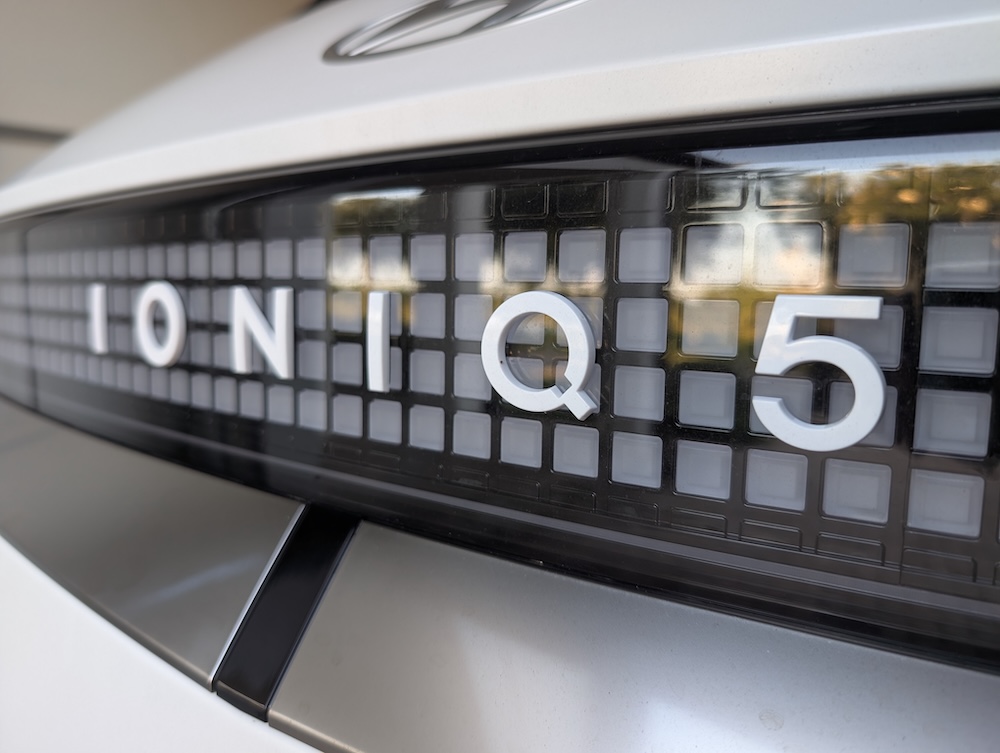
Also, the car just has a ton of personality. It has weird sharp angles and this recurring pixel pattern in all of the lights. The contrasting gray trim is interesting. I think it's a good looking car, and not just another cross-over blob. The inside is comfortable, too, even in the back seat. It has a little less cargo room than a Model Y, but I've still got two of those hanging around if I need the room.
Charging and range
One of my requirements in the car search was that it had to have an NACS port, better known as the "Tesla connector." It's derived from existing standards anyway, so maybe it doesn't entirely matter, but I wanted to have that native to the car, without an adapter. The Ioniq 5 also has NACS, and an 800 V architecture, so it can theoretically charge faster than a Tesla at a charger that's fast enough.
The charging cable it comes with includes a standard wall plug and a NEMA 14-50, which is what we already have in the garage. That means level 2 charging at 240 V at 30 amps, or about 7 kW. That works out to around 28 miles per hour, which is more than fine over night. At newer superchargers, it should do 10 to 80% in about 20 minutes, and some Electrify America chargers can use the full 800 V and do it in 18 minutes. As I've said before, on the rare occasion you need public charging, you're probably stopping for food or potty anyway. This is a non-issue that people make too much of a big deal out of.
The car is rated for a 318 mile range new. As I'm nearing the end run of a full charge, it looks like it'll be close to 340 miles. That makes sense, because so far it's showing 4.1 miles per kWh, and the battery's useable bit is 84 kWh. That's pretty great, with summer AC (and seat ventilation!) running. The Model Y tended to do 3.4 miles, sometimes less, in similar conditions. So with electricity spiking to almost 16 cents per kWh lately (used to be 12 cents), that's solid. And 4 cents per mile is still way lower than 13 cents when gas is $4/gallon and your car does 30mpg.
All the gadgets
Like I said, I held out for a Limited, and it does not disappoint for a gadget geek. Having a phone key was non-negotiable, and only that trim had it. The infotainment and mapping is actually pretty good. There's a charging pad right in the arm rest for your phone, and it supports Android Auto and Apple Carplay. Auto/Carplay is not really that necessary, and the car has a SiriusXM radio. The only gap is a podcast app, so I need my phone for that. The problem with wireless Android Auto though is that the phone gets really hot on the charger, to the extent that it throttles performance. It's a little better if you plug it in, but that's not as convenient. If it just worked without the heat, I'd be fine to use it all of the time, but otherwise, the in-car mapping and audio are fine.
The fancy things are a lot of fun. The heads-up display is impossibly bright, even in bright sun. The ambient lighting is cool at night, especially in blue. The Bose speakers are good, and there's a subwoofer. The 360 camera when parking is neat, and the turn signal cameras are vastly superior to Tesla's, in part because they're in front of you. Ventilated seats are life changing, and essential in Florida summers.
Most importantly, and this was a significant reason to look for something else, is the physical buttons. All of the primary computer functions have a physical button, with volume and tuning knobs. The seat ventilation and heat are on buttons. The HVAC is capacitive buttons, but at least they're not on a screen. The biggest mistake from Tesla is ditching the stalks on the steering column, including the turn signals. That's not a problem here.
The camera screen in the rearview mirror is neat, but not practical because it forces your eyes to refocus. Remember, a mirror allows your eye to focus far away from the car, but a screen that close forces focus that close. If you need glasses in either direction, this breaks that, and even for perfect eyes, the refocus required looking out the windshield to the mirror screen is a lot.
Hyundai's app is not very good either. It does this weird thing where you fire off a command and it sends you a notification. Part of it is not the app, it's the architecture decisions they made, because you don't have a streaming data connection to the car when you have the app open, like you do with Tesla. Under the hood, it sends a command, then every few seconds asks, "Are you done yet? Are you done yet?..." I'm building my own app, and I'll put it up as open source.
Conclusions
Having to reset the driving mode and braking mode every time is annoying. Having a power button, and no automatic walk-away locking is also suboptimal. These are not great quirks. I suppose muscle memory will resolve that eventually. Fortunately, there are a ton of positive quirks that give the car a lot of personality, and I really dig that. All of the tech stuff is not really that necessary, but it's still super cool.
I'll have to follow up later, to see if I'm still infatuated with it then. The initial impression is very strong.
Rethinking college (decades later)
posted by Jeff | Thursday, July 23, 2026, 12:00 PM | comments: 0As a proper Gen-X'er, I was sold the idea that college was the natural progression toward a normal and reasonably prosperous American future. I ended up studying journalism and radio/TV, neither of which has been particularly relevant to my career since I turned 26. I graduated with a GPA of 2.65, C+'ing my way through a bunch of academics that I didn't care much about. Granted, I know now that ADHD had a lot to do with my suboptimal study habits. It was often socially difficult, because of the ASD I didn't know about, but I still consider the experience rewarding for a lot of reasons. If nothing else, I would't have been ready for the real world after high school.
Right before Simon was born, I moved to Seattle and started at Microsoft. There I met a ton of people that were around five years younger, none of which went to college. They were graduating from high school right in the middle of the dotcom boom, around the turn of the century, and living in Seattle. There was no reason to go to school if they were self-taught in coding and could get hired. It challenged my long-held belief that you needed college to make a solid living.
Today, I have a 16-year-old, and for now, it seems unlikely that he'll go to a four-year school, if any school. He has the same atypical brain as me, and he doesn't really care for school. He sees potential working in hospitality or theme parks, of which there are opportunities here. Housing costs suck, as they do in most places, but he can see a future there. I think he has a good shot.
So it's not surprising that his generation, and those a little older, are somewhat disenfranchised about college. I get it. It doesn't help that the cost has become insane. Millennials all went and got graduate degrees and loaded up on the debt, with little payoff. If we had free college and didn't tie jobs to healthcare, I think the outcomes would be vastly different, but we're not Scandinavia, unfortunately.
Lots of changes
posted by Jeff | Friday, July 17, 2026, 8:03 PM | comments: 2I'm alone this Friday night. Diana is working which is fairly typical. But Simon is, for the first time, at the parks by himself, having driven himself. Yikes.
Things are strange. But it's not really bad strange, and in fact I've been kind of craving change after the last six months. Simon being mobile isn't something I necessary looked forward to, but at least in the last few days, he's been uncharacteristically responsible. He emptied the dishwasher without prompting, and helped clean up the garage a bit. We've sent him out to drop some things off to be recycled, and he picked up groceries.
I'm in my second week at a new job, which is equal parts exciting and terrifying. Diana is in a new job too. My neighbor moved out, which means we can open those blinds in the side windows. I have a new car, which is symbolic of a lot of things, and would be a little midlife crisissy if it weren't a Hyundai. The kittens are growing up fast. It seems like a political correction is likely, too.
It's not all good. One of my college classmates, a guy everyone liked, died this week of a heart attack. We're at the age now where that sort of thing will only become more frequent. Our movie stars and musicians are passing as well. We get weird pains we didn't have before. We see doctors to manage conditions.
It's all about how you view the world, I suppose. Time is coming for all of us, and the only way to live for whatever time you have left is to accept that. Combined with gratitude toward the people who make your life amazing, and the good things you've seen, I believe that it's possible to live in a content way. You can decide to go to bed with a smile, and look forward to the day every morning. The decision is easy, but the follow through can be tough. I gotta work on that.
Car buying was exhausting
posted by Jeff | Wednesday, July 15, 2026, 7:43 PM | comments: 0I finally landed a car, and it ended up being new. It was an exhausting process. But whatever, I think with the year I've been having, I deserve it.
I actually got a pretty good deal from one dealer, but the car I wanted was spoken for. Then looking around town, they were generally in short supply. I settled on a Hyundai Ioniq 5, with a Kia EV6 as my back up plan. They're built on the same platform, but the latter is a little smaller and sportier. The wrinkle is that I wanted the highest trim, because of all the tech and stuff that comes with it. That includes upgraded sound, digital (phone) keys, ambient lighting, among other things. Oh, and ventilated seats, which are life changing. Can't believe that didn't become a thing sooner. Anyway, I was looking as far away as Gainesville for these things.
(Sidebar: There was an article today in the NYT about Detroit's failure to get any foothold at all in the EV market, especially outside of the US. Yet another industry that cedes leadership to the rest of the world.)
Eventually, I found a local dealer that had the car in the trim I wanted. They're one of the non-negotiating shops, like the one that made the earlier deal, but this one was effectively a grand and change more expensive. Given my general exhaustion in the process, I just gave up and bought it. Almost a week of looking was enough, especially since I started with the asshats selling used cars. None of them are honest, and they're all terrible. The dealer I bought from worked entirely via text message, and when I got a number I could live with, we drove out to get the deal done.
This is the first car that I've ever bought outright, which I'm very proud of. Even ten years ago, I couldn't imagine doing that, but the saving discipline has been worth it. Well, technically I did finance it, because that knocked $7k off of the price that I couldn't negotiate. So I'll just pay that off immediately. As the AI bots warned, the finance guy made up some stuff about bad things happening if I paid it off too fast, but that's because they just lose whatever margin the financing enabled. But they're not going to lose money, they just won't make thousands. This particular contract had a "gotcha" in that there's a $75 fee that they "may" charge you inside of six months, but it still beats thousands in interest. Rates suck right now.
The car is quirky as hell, in good ways mostly, and with a few minor annoyances. I'll write more about it after I've spent some time with it.
Autism: The super power for car buying that exhausts
posted by Jeff | Sunday, July 12, 2026, 11:02 PM | comments: 0I did the math, and I've bought 13 new cars. That's nuts. Of those, I had to negotiate a deal for 10 of them (the other three were Tesla online orders). The first one, a Toyota Corolla that I leased right out of college, was not a very good deal, because I didn't know what I was doing. But my dad filled me in on all of the dumb shit that they do after that, and I'd consider him an expert since he sold retail loans through a bank. My next car was also a Corolla, and it was an OK deal.
Car #6 was actually Diana's Hyundai Elantra circa 2008. We were living together by then, but just starting to commingle our finances. It was her name on the loan, but I kind of took the lead on negotiating because, well, I just found it sporting. The circumstances that day were ideal though, because the dealer wasn't busy, it was late in the day, late in the month, and instead of doing the "ask my manager" dance, the manager sat down with us. We got it below the invoice, knowing what the dealer incentives were and such, and I had worn down the guy. As people started disappearing, he got pretty candid. "Look, this is the margin we're going to be left with, and I gotta give this guy [the sales rep] something, and we need to pay for the Taj Mahal here [the new dealership]." I felt pretty good about it, and I think he just wanted us to get out of his showroom. We had that car until 2014, when the transmission blew, but was replaced under Hyundai's excellent warranty. That's when we experimented with our first EV, the Leaf.
That was a pretty terrible experience, but it ended right. A young dude was doing "Internet sales" at the time, and he wanted to do right by us. We were going to lease, because going electric, with a car rated for an 84 mile range, carried some uncertainty. I was all-in, because average American commutes can easily accommodate that range, which is what you do 99% of the time. And you could squeeze out 110 miles when you weren't using AC. You charge at home. In any case, we left that dealer without a deal, and the three of us went to a Tijuana Flats down the road. While eating, I got a text from the dude, saying that his manager agreed to the cap cost I wanted. That's the actual cost of the car, plus fees and tax and such. (Pro tip: If you're gonna lease, don't even bring it up... negotiate the price of the car only, regardless of trade and financing, then use that as the cap cost for a lease.) I think I agreed to put down $6,000, and our lease payment was like $105. And what we got is what I hoped for... they let us keep extending the lease. Our per-month cost was stupid low.
Anyway, I'm in a spot now where I have to acquire another car. My kid is 16, I don't think he'll go to college, so I have to figure out how best to set him up for success. I know that part of that absolutely involves him having reliable transportation. I got along without a car until late in my junior year of college, but my (home) parents never even pushed me to get my license, and that's still infuriating. He has his license, because we pushed for it, and now he needs a car, even if it's just for school. Ideally for a part-time job.
Before I got laid-off, my intention was to buy a sweet car for me, and give him mine, which is now 5-years-old. While I wasn't working, I hoped that maybe I could just find him a cheap-ass EV, like a first-gen Leaf. Going down that road has been difficult, because used car dealers are shitty and shady. So I'm back to looking for a replacement for my car. Disenchanted with Tesla build quality and screens and capacitive buttons, I'm targeting a Hyundai Ioniq 5 or Kia EV6, which are built on the same platform and roughly equivalent. At one point I thought about something more luxury, like a BMW i4, but they discontinued it in favor of a future i3, and it's still too expensive. The Hyundai/Kia is stacked with cool tech, which is what I'm really interested in over luxury.
So today's work is to try and land one of those. Going back to those earlier experiences, the reality is that my brain is wired to want the thing, but not make it an emotional issue. And that's real, because even going back to that experience with Diana buying the Hyundai, I was ready to walk away at any point. The dirty little secret is that while it's not emotional, per se, it is not without cost. My brain considers any challenge or not getting what I want as a personal affront to me. I logically know it's not, but some combination of my teenage bullying and my wiring to be logical and right feels shitty. The whole thing is not without cost.
I'm at a good news/bad news situation. I fully understand the scenario with Hyundai for what I want, but the two local dealers I was talking to don't have the cars in the trim I want. One gave me a full on offer with the right numbers that would ultimately allow me to buy in cash (a lifetime first, I would add). The details are unimportant for now, but I "won" as I wanted to. A legit EV and the deal I wanted. So I've started to look toward the Kia equivalent, which is the same "skateboard" but with a somewhat different shell on top. Three players in the Orlando market, but the first one I contacted is bullshitting me to the nth degree and kept insisting that I come in to chat, which I absolutely will not do. I'm trying to hand them a softball, with all of the right terms that make it (theoretically) a profitable score for them. (I'll come back to that if I can land what I want.) And this fucker wouldn't budge.
Again, in the long term, I know that I can likely get what I want, but the psychological overhead is taxing to say the least. The explicitly logical part of my head is pleased at doing the right things, but the feeling that I'm being fucked with is expensive. I just don't like being fucked with.
Hopefully I'll soon have a good story to share at the end. Mind you, that good story will be loaded with detail about how fucking expensive it is to have a teenager who drives. The upside is that the various AI agents have the ability to discover all of the angles and coach you on this. Maybe I need to just have them outright work on my behalf.
First days of work
posted by Jeff | Sunday, July 12, 2026, 1:59 PM | comments: 0Honestly, I'm still trying a little to reconcile the loss of my previous job. I've never been in one place for four years, and I miss the people. But what I found seems to be a better job with better opportunities and pay, so I'm happy with how it ultimately turned out.
I started on an odd week though, because it's the week that they take off to do a massive hackathon. Mostly small projects by small teams. I didn't have a lot to contribute, because I know so little about any of their systems, but I got to know a couple of people I wouldn't otherwise talk to much, so that was cool. Next week I still have onboarding sessions to do, but I'll begin the fan-out to meet all of the people that I need to know.
I haven't had a cold start like this in, well, four years of course. It's funny how it still reminds me so much of starting a new school year, only without the bullying and hormones. It's exciting, though a little stressful, because you generally want to prove that you're adding value quickly. But tomorrow, things will start getting real, and I have people to hire! Haven't added a new person in two and a half years, so it's been awhile.
Mo money, mo problems
posted by Jeff | Wednesday, July 8, 2026, 7:55 PM | comments: 0Now that I'm employed, of course things are coming up, going down and breaking. I mean, sure, better now than a month ago, but I can't catch a break.
First off, our fridge is toast. After de-icing it twice, I figure the heating coil is dead. And then, speaking of ice, the ice maker stopped working. It turns out that this KitchenAid model, along with Whirlpool and other related brand models, have a fatal flaw in the bottom of the door hinge, where the wires eventually crack and break, killing the ice maker and eventually the controls. I tried to put some wire lever nuts in there, but there's almost no room to work there. So F-it, I'm done trying to bandaid the thing. Annoyed that the thing didn't even make it to nine years, and that I only bought it so the handles matched the other appliances that came with the house. Ordered a basic-ass LG to replace it. Our washer and dryer are LG, 15 years and counting, with only a leaky valve replacement that I was able to fix myself.
Now that Simon is 16, it's time to get him licensed. I knew the insurance would be bad, but didn't realize it would be double what we pay bad. That more than reverses the recent rate recovery we got here in Florida. It's going to be about $2,800 annually. We want to get him a cheap used car, and it looks like we can score an old Nissan Leaf for under $5k, which would only be $100/half to insure. And he won't be able to go very far in it either. At one point, I figured that I'd get a new car and give him mine, a 2021, but I don't want car payments anymore. We have EV's in Florida, so no rusting, no real maintenance, and they should last a very long time.
We've been putting off carpet replacement for a few years, but it looks so bad that I'm starting to hate my own house. "Builder basic" doesn't even begin to describe the crap that Pulte used. It looked bad after five years, and now we're at nine. I guess we'll probably start with my office and the front room, and if we like the service from the chosen vendor, we'll use them to do upstairs. That's not gonna be cheap. We have some rugs that are in pretty sad shape, too, but those are hopefully cheap fixes.
Owning stuff is expensive, but I suppose it's better than renting or leasing stuff. Well, cars are always a losing proposition, and I have to try hard to resist new cars. I get a lot of joy from driving, but not all of the time. And I'm a gadget nerd, and they're basically big gadgets. At least I'm not a car status guy.
Contemplating a 250-year-old America
posted by Jeff | Saturday, July 4, 2026, 12:25 PM | comments: 0It's not uncommon for people to frame history relative to their own experience, and I suppose I'm no different. US history isn't very well taught in school, let alone local or state history. Growing up in inner-city schools in Cleveland, especially during desegregation, exposed me to a lot of things I probably would not have learned in the suburbs, and I'm grateful for that foundation.
Being a Gen-X'er is interesting because our historical frame is so different from the generations before and after. Those before us knew war in a different way, and were witness to the civil rights movement. Those who came after didn't really know life before the Internet. We got to see top-40 radio at its best. We lived under the constant thread of nuclear annihilation, but also saw the Berlin wall come down. College education grew as a viable and meaningful way to transition to adulthood. The AIDS epidemic hit. We had a front row seat to the birth of the commercial Internet. Then 9/11 happened, just as we were figuring out adulthood. Years of war with little to no benefit ensued, but unlike wars that came before, this one had no draft, vague goals, and it cost more than all of our previous wars combined, adjusted for inflation. They were funded entirely by deficit spending. Meanwhile, a combination of private and public efforts made extraordinary advances in science and medicine. For awhile, we led the world in this way.
The preview for negative change started with the erosion of journalism, the fundamental means of keeping government accountable. The Internet broke local journalism entirely. Local newspapers, even if they did online right, struggled to survive. There wasn't much money online for the coverage of city council meetings and high school sports. At the national level, there was also a shift underway. I remember when the bombing began in Iraq, I was channel surfing through cable news channels. Fox News was showing a waving flag banner, which I read as taking a side, not reporting. People were dying, live on TV, and they were quite literally waving a flag. Suddenly the "news" that questioned the government was telling you not to question the government. I dismissed it as a fluke at the time. Surely the institution of the American press was not going to radically change.
But something changed specifically in 2008. It was subtle at first, and it had something to do with the election of a black man with a somewhat unusual name. Politics were always somewhat divisive, but the election of Barack Obama inspired a new divisiveness that we had not seen in our lifetime. People were already angry at the state of things, with the Great Recession, ongoing war and a housing crisis that persists today. The discontent among many Americans was rooted in the feeling of being unseen, of government not serving them. Fiscally, this was likely somewhat universal, but starting with the Tea Party folks, they saw an opportunity to leverage the discontent of a portion of that cohort through coded racism and culture wars. The same people that leaned into personal responsibility started acting as the victims, blaming people that were different for everything that ailed them.
So Americans decided they wanted change again, and you know how that went. The change came with a basic lack of decency and decorum, and the racism, antisemitism and xenophobia stopped being coded and started being blatant. We voted against our own self-interest again, and now, with a pointless war and inflation out of control, we have a government that tears down parts of the White House, obsesses about things that don't matter to regular folks, and we have a congress that let's it happen. Indeed, at this 250-year point, I wonder if we'll see 300. I don't recognize the country I live in. The vice president actually said that if Nixon were to commit his crimes today, it would be no big deal. That doesn't land the way he thinks it does.
Despite this, I remain optimistic. While the cult of personality suggests that embracing the contradictions in our history is unpatriotic, I argue the opposite. In fact, it's time to take patriotism back to mean something more than a campaign slogan. Many of our founding fathers were slave owners, yet the America that they wrote about celebrates its ability to improve. These were flawed men that sought a higher ideal. Continuous improvement was always the goal, because they knew that "all men created equal" didn't really mean "all men" at the time. The Constitution and the system that it lays out is meant to change, because the authors were self-aware enough to know that they couldn't get it right all at once.
We must also look to history to observe the causes of societal failure. Autocracies do not endure. Wealth inequality contributed to the end of the Roman Empire, third century China and the French monarchy. We are not infallible, and yet we seem willing to embrace these qualities for the moment. But again, our system allows for course correction, and there's evidence that we're headed in that direction.
Our nation was founded and built by immigrants. The vitriol pointed at the immigrants of today is misguided. Again, history shows that our greatest eras of prosperity happened during the heights of immigration. It has never come at the expense of those born here. They're historically less likely to commit crimes than those born here. And of course, more people mean a higher GDP that benefits everyone. It's just math.
We can't celebrate freedom without allowing for freedom of the press, health autonomy, the ability to vote without burden and the ability to move freely without fear of arrest for the color of our skin. These should not be controversial.
With two and a half centuries under our belt, we can be sure that we're only caretakers and stewards of this nation. We're ephemeral. The question is, what will people say about us when we're gone? Did we live up to the promise of America? It's not too late to make sure that we do.
Last day of funemployment
posted by Jeff | Friday, July 3, 2026, 3:05 PM | comments: 0I return to work on Monday, so today ends the unjobbed time. Technically, it's as long as the six-month lapses in 2001 and 2009, but those were a lot different, with recessions in play. This time, I didn't even spend much time looking for almost two months. I was ready for a little sabbatical. Then Diana's appendectomy and subsequent related issues came next. I would measure this more around four months, which is maybe a hair longer than normal. When I look back, gosh, it happens a lot in my line of work.
Time moved kind of slowly this time around, which is welcome for anyone middle-age and feeling like time is getting away from you. The absence of routine always slows things down. Psychologically, it was challenging for different reasons. The financial situation was better and worse than previous. With a fat severance, there was no hurry. I never applied for unemployment. On the other hand, I also started to game out what offboarding from my tech career really looked like. I solidified the idea that I don't want to wait for "retirement age," which is still so far away. I did the math, and I'm realistically in "FIRE" range by a year or two. Provided that Diana had health insurance for us, I could have possibly made it work today, but our investments aren't liquid enough. That, and the volatility caused by an unstable guy in the White House means the market is constantly up and down. So I was simultaneously in great shape, and not close enough to make a safe change.
I had no problem finding purpose. Building out TogetherLoop was super fun, and I really shored up all of my coding projects. I made the most of my $20 monthly Claude subscription, and I've never had more fun doing this sort of work. I wouldn't want to code full-time again for work, but AI makes it so that you can concentrate on technical design and architecture, which is the stuff I'm most interested in. I also spent a fair amount of time building LEGO, playing video games and hanging out with Diana and Simon. We had two cruises already on the books, so we did those, too.
My biggest source of angst and anxiousness came from the job hunting itself. The job market has technically been stable, and the reporting around "tech layoffs" tends to be more with the giants than medium or small companies. What has changed in the four years since I last had to look is the way recruiting and interviewing goes. It has not changed for the better. That alone is worth its own blog post. I'm certain I applied to 200 job listings, and scored zero calls from them. The action that I did get was all from referrals. Some of those interview loops were as broken as the rest of the process, and even though I knew it wasn't personal, it really wore on me. Combined with a very challenging parenting season, especially with me being the most accessible to Simon, and I got to be a hot mess at several points.
That's all behind me now, and for the first time in my life, I have an idea of where I expect to be in five years. People ask you about stuff like that all of the time, and I never have a very specific answer. This time, I do. And the job I landed has so much potential, and I'm already seeing it just in the onboarding and setup prior to starting. It's pretty exciting. I haven't looked this forward to starting a new job since Microsoft.
Now's the time to make software suck less
posted by Jeff | Wednesday, July 1, 2026, 10:10 PM | comments: 0Like many software people, I often play the role of tech support at home. My experience means that I can generally imagine what went on at the company that made it, and why it sucks. And by the way, most of it sucks. I'm not sure why we tolerate it, other than there's little incentive to make it better if you're competing against more suck. It's infuriating.
Most recently, my wife got a new phone, and the credentials for the Ring app didn't transfer over. She's been trying for weeks, and the requirements to unlock her account were ridiculous. Even better, when you try to recover your account, it spawns a help page that tells you to enable recovery options. In the account that you can't enter. I can't make this stuff up. And don't even get me started on the trash in the academic world. Our school district does their best at integration, but much of it is garbage. That makes my kid rage. Speaking of rage, try making anything with Google's FamilyLink work right or in a predictable way across Google products. Total trash.
So I call upon my fellow software people... we must put an end to crappy software. Enough already. I keep seeing all of these hot takes about productivity and how everything is easier and faster to make (and somehow more expensive, too). The outcome least spoken about is making software better. No one cares if you can sling 20 agents at a time churning out code based on incorrect assumptions. Agent slinging is not an outcome or a functional requirement. It's not in your product requirements at all. It's not in your mission statement or business plan. No one ever said, or will ever say, "I love this software, they must have made it faster with AI!"
If your software does not delight, turn on the red light. Get it in front of people early and often. Feel the customer pain. Listen to what they have to say. If we're going to leverage this new found power of agentic coding, let's use it to make software better. That should be the goal.